
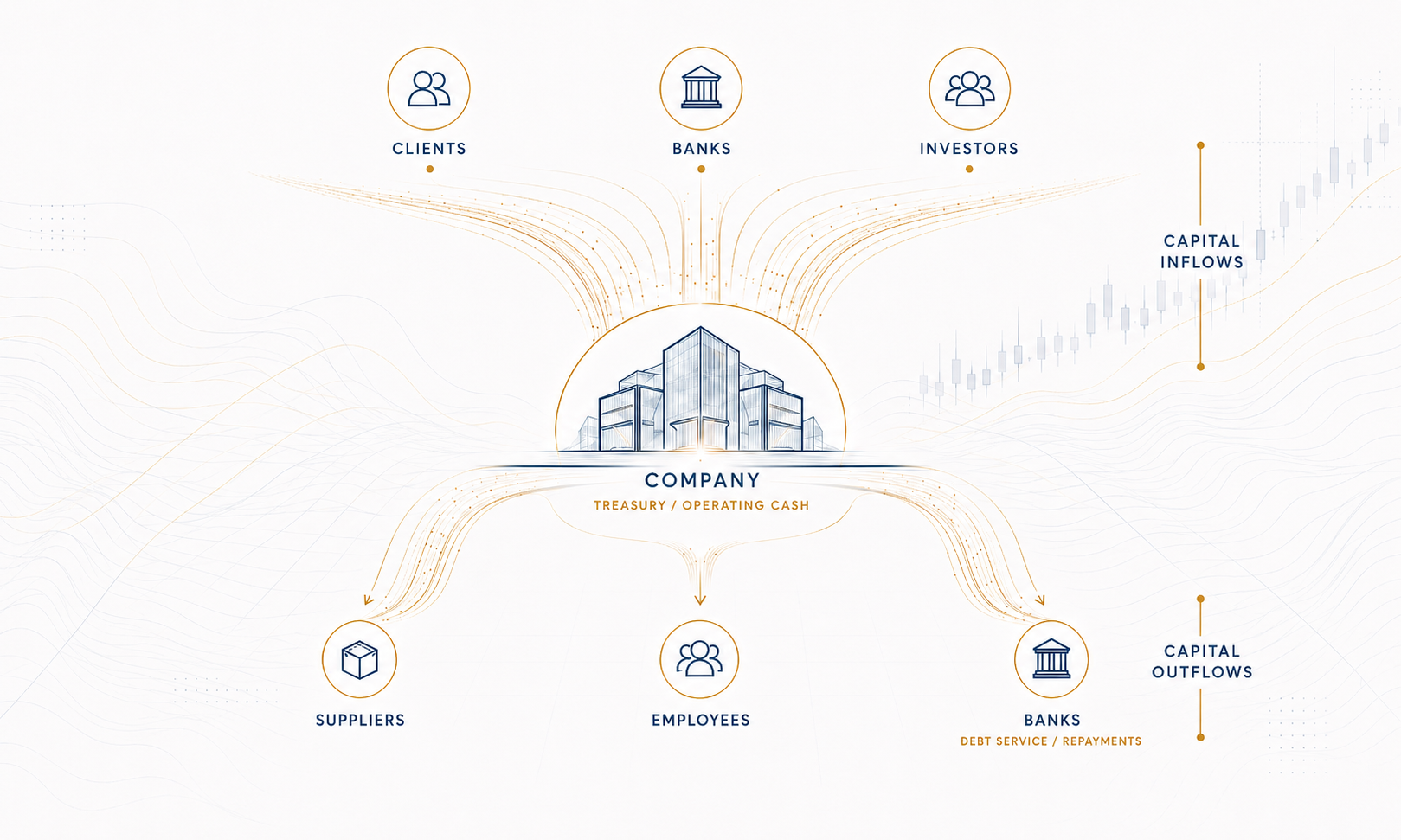
A structured capital base can give industrial companies more than financing. It can create resilience, protect execution capacity, and strengthen institutional credibility.
The cheapest capital is not always the least expensive.
Capital structure is not only a financing question. For industrial companies, it is often a strategic operating question that affects resilience, growth capacity, risk exposure, and institutional credibility.
Regional industrial groups frequently operate with complex asset bases, cyclical demand, working-capital pressure, supplier dependencies, and long investment horizons. In that context, capital structure should not be designed only around the lowest available cost of debt. It should be designed around the company’s ability to execute its strategy under both base-case and downside conditions.
Understanding the operating reality
A disciplined capital structure review begins with the operating reality of the business. This includes revenue concentration, margin stability, capex requirements, inventory cycles, customer payment behavior, debt maturity, covenant flexibility, and exposure to market or regulatory shocks. These factors determine how much financial pressure the company can absorb without weakening execution.
Connecting financing to strategic priorities
The next step is to connect financing structure to strategic priorities. A company preparing for expansion, modernization, export growth, or acquisition activity needs a capital structure that supports investment without creating unnecessary fragility. That may require refinancing, maturity extension, improved reporting discipline, a clearer lender narrative, or a staged capital plan linked to measurable milestones.
Preserving strategic optionality
The strongest capital structures are not always the most aggressive. They are the structures that preserve strategic optionality, withstand institutional diligence, and allow leadership to act with clarity when conditions change.
The strongest capital structures are not always the most aggressive. They are the structures that preserve control when conditions change.
HP Invest perspective
For HP Invest, capital structure optimization is therefore treated as part of a wider institutional readiness process. The objective is not simply to arrange capital. The objective is to align capital, governance, reporting, and execution discipline so the enterprise can move with greater control and credibility.